What is Rust and why does its compiler stop so many bugs before your code runs?
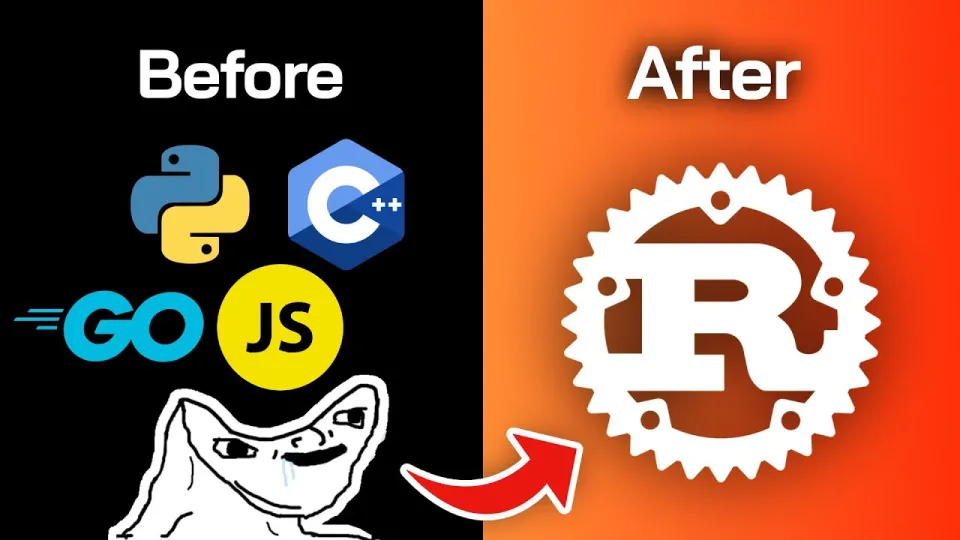
Video: Rust for Dummies in 12 Minutes
Want articles like this for your own video to promote it on YouTube and Google? Order them through the Telegram bot @sat_sit_bot. The bot writes and publishes the articles itself (with your YouTube video embedded) on popular topical websites (no ads). Free trial — 50 articles.
· based on the channel Let's Get Rusty
Rust is a compiled programming language that enforces memory safety at compile time instead of relying on a garbage collector or on the programmer's discipline. It achieves this through ownership, borrowing and a strict type system, so a whole class of crashes and data races is rejected before the program ever runs. Developers who want to go further can join the Rust Live Accelerator waitlist, which includes a free Rust Job-Ready Roadmap.
What is Rust in plain terms
Rust is a systems language: it compiles to native machine code, gives you low-level control over memory layout, and is used for operating system components, command-line tools, web servers, embedded firmware and WebAssembly modules. What separates it from C and C++ is not speed but the set of rules the compiler enforces. The compiler, rustc, refuses to build a program that could read freed memory, use a value twice after it was moved, or mutate data while another part of the code is reading it.
That trade is deliberate. You spend more time fighting the compiler and less time debugging production crashes. The language has no null by default, no exceptions, and no hidden implicit conversions; instead it pushes those concerns into types you must handle explicitly.
Why Rust code does not break
The central idea is ownership: every value in Rust has exactly one owner, and when that owner goes out of scope, the value is dropped and its memory is released automatically. There is no manual `free` call and no garbage collector pausing your program, because the compiler inserts the cleanup at compile time based on where variables live.
Three rules follow from this, and they explain most beginner errors:
- Assigning or passing a value by value moves ownership to the new location; the old variable can no longer be used.
- You can lend a value instead of moving it by taking a reference, which is called borrowing.
- At any moment you may have either any number of immutable references or exactly one mutable reference, never both at once.
That last rule is what prevents data races. If two threads could mutate the same data simultaneously, the borrow checker rejects the program, so concurrency bugs that would be intermittent and painful in other languages become compile errors. The same mechanism rules out use-after-free and double-free bugs, because a value cannot be freed while a reference to it exists.
The genius of Rust's type system
Rust's type system turns runtime surprises into compile-time obligations. The two workhorses are `enum` and the standard types built on it: `Option<T>` for a value that may or may not exist, and `Result<T, E>` for an operation that may fail. There is no implicit null; a function that might not return a value says so in its signature, and the caller must handle both cases, typically with `match` or the `?` operator.
This is why Rust programmers talk about making illegal states unrepresentable. Instead of a struct with a boolean flag and several optional fields that can be combined nonsensically, you define an enum whose variants carry exactly the data each state needs. The compiler then guarantees you cannot read a field that does not exist in the current state.
Traits work as the shared-behaviour mechanism: a trait declares methods, and any type can implement it, which gives you generics and operator overloading without inheritance. Pattern matching forces you to cover every variant, so adding a new case to an enum surfaces every place in the codebase that needs updating.
Rust compared with C, C++ and JavaScript
The honest comparison depends on which version of the other language you mean. Modern C++ has smart pointers such as `std::unique_ptr` and `std::shared_ptr` that free memory when they leave scope, which is conceptually close to Rust's ownership model, so the classic malloc-and-free critique applies mainly to older C-style code. Rust's difference is that the safe subset makes these guarantees mandatory and checked, rather than a convention good teams follow.
Against JavaScript, the contrast is starker. JavaScript is dynamically typed and garbage collected: passing a string where a number is expected often fails silently or produces a confusing coercion at runtime. Rust checks types before execution, so a mismatched argument is a build error with a message pointing at the exact line. Rust also compiles ahead of time, which is why installing a Rust-based command-line tool on Linux means a compile step but then a single self-contained binary that just runs.
Who should learn Rust and how to start
Rust rewards people who already feel the pain it solves: developers maintaining large C++ codebases, backend engineers chasing concurrency bugs, and anyone who wants to contribute to open-source projects written in Rust. If your main goal is shipping a small script today, a garbage-collected language will be faster to write; if you need predictable performance and long-term maintainability, Rust pays off.
A workable path looks like this:
- Install the toolchain with rustup and learn `cargo new`, `cargo build`, `cargo run` and `cargo test`.
- Work through ownership, borrowing and slices until the borrow checker's messages stop feeling arbitrary.
- Learn `Option`, `Result`, `match` and the `?` operator before touching async or macros.
- Build one small real tool, such as a file renamer or a log parser, and read the compiler errors carefully; they usually tell you the fix.
Expect the first week to be slow. The friction is front-loaded, and most learners report that ownership clicks suddenly rather than gradually.
Common doubts about Rust
Several recurring worries deserve direct answers. The first is that Rust is only for low-level work: in practice it is used for web services, CLIs, game engines and data tooling, and its package manager and build tool, Cargo, is one of its strongest selling points. The second is that the compiler is too strict to be productive: in safe Rust you can still use interior mutability and reference counting when a design genuinely needs shared ownership, so the rules are bendable with explicit, visible cost.
The third doubt is readability. Rust codebases can look dense because of generics, traits and lifetimes, and teams differ in how idiomatically they write. The fourth is whether safety eliminates all bugs: it eliminates memory-safety and data-race bugs in safe code, but logic errors remain entirely your responsibility, and `unsafe` blocks step outside the guarantees.
Where to find the source material
The breakdown this article draws on is the video Rust for Dummies in 12 Minutes from the channel Let's Get Rusty, split into two parts: why Rust code does not break, and the genius of the type system. The channel also runs a structured program for engineers who want job-ready skills, and the entry point is the Rust Live Accelerator waitlist.
Summary
Rust is best understood as a language that moves bug detection from runtime to compile time: ownership and borrowing govern memory, and enums such as `Option` and `Result` govern missing values and errors. The cost is a steeper learning curve and more verbose signatures; the benefit is code that does not crash from use-after-free, double-free or data races in its safe subset. The 12-minute breakdown by Let's Get Rusty is a compact introduction to exactly these two pillars, and it is a reasonable first stop before working through the official book and building a small project of your own.
Key takeaways
- Rust is a compiled systems language that enforces memory safety at compile time, without a garbage collector.
- Ownership rules mean each value has exactly one owner, and memory is freed automatically when that owner goes out of scope.
- Borrowing lets code reference a value without taking ownership, with the compiler rejecting conflicting mutable and immutable references.
- Rust's type system uses enums, Option and Result to make missing values and errors explicit instead of silent.
- The Let's Get Rusty breakdown 'Rust for Dummies in 12 Minutes' covers two parts: why Rust code does not break, and the genius of its type system.
Questions & answers
Is Rust really harder than C++ or JavaScript?
Rust is harder at the start because the compiler rejects programs that other languages would run, so you meet ownership and borrowing immediately. Once those rules are internalized, most developers find day-to-day work comparable to C++ and more predictable than large JavaScript codebases. The difficulty is front-loaded rather than permanent.
Do I need to know C or C++ before learning Rust?
No. Rust does not require prior systems-programming experience, and many learners come from JavaScript, Python or Java. Knowing how memory works helps you appreciate why ownership exists, but the language teaches its own model from scratch through the official book and Cargo-based exercises.
Does Rust's compiler catch logic bugs too?
No. Rust's guarantees cover memory safety, data races and exhaustive handling of enums in safe code; a wrong formula or an incorrect business rule still compiles and still misbehaves. Logic correctness remains the programmer's job, which is why testing with cargo test matters as much as in any other language.
Why do Rust projects compile slowly during installation?
Rust compiles ahead of time to native machine code, and tools installed from source build their dependencies first, which takes time once. The payoff is a single self-contained binary with no runtime or interpreter to install. Incremental builds and caching in Cargo make later compilations much faster.